

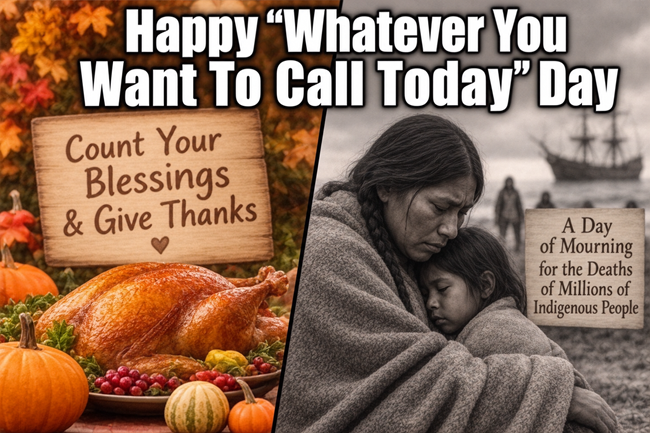
Well, here it is, Turkey Day 2026 in ‘Merica. Some people believe in the cute story of the Pilgrims and “Indians” as the origins of the holiday, but the reality is slightly different.
Thanksgiving began as a blend of autumn harvest festivals and religious days of thanksgiving in 17th-century colonial New England, before becoming a U.S. national holiday in 1863 during the Civil War.
Early Colonial Roots
1621 Plymouth Harvest: After a harsh first winter, English settlers (Pilgrims) at Plymouth Colony and about 90 Wampanoag people led by Massasoit shared a three-day autumn harvest feast. It featured game birds, deer, corn, and shellfish, without modern staples like pumpkin pie or mashed potatoes.
New England Traditions: Local days of thanksgiving and fasting developed across New England colonies. Plymouth declared its first civil day of thanksgiving in 1623, and harvest thanksgivings became regular regional observances by the 1660s.
Becoming a National Holiday
Early Proclamations: During the Revolutionary War, the Continental Congress and George Washington proclaimed days of thanksgiving. In 1789, President George Washington issued a national thanksgiving proclamation following the creation of the U.S. Constitution.
1863 Civil War Proclamation: After decades of advocacy by writer Sarah Josepha Hale, President Abraham Lincoln declared a national Thanksgiving in November 1863 to promote unity amid the Civil War.
In case you were wondering how the Civil War Proclamation came about:
Sarah Josepha Hale’s Crusade: Beginning in 1827, writer and influential magazine editor Sarah Josepha Hale (editor of Godey’s Lady’s Book and author of “Mary Had a Little Lamb”) campaigned tirelessly for a single, fixed national Thanksgiving. Over 36 years, she published editorials and sent letters to governors, senators, and five consecutive presidents—Zachary Taylor, Millard Fillmore, Franklin Pierce, James Buchanan, and finally Lincoln—arguing that a shared holiday would bind the country together.
Fourth Thursday of November: In 1939, President Franklin D. Roosevelt shifted the date to boost holiday shopping, and Congress officially set the holiday on the fourth Thursday of November in 1941.
Indigenous Perspectives and Later Context
Shifting Relations: Early cooperation between Plymouth settlers and the Wampanoag—who had lost much of their population to earlier epidemics—gave way to land disputes, English legal impositions, and conflicts such as King Philip’s War.
National Day of Mourning: Many Indigenous people view the Thanksgiving narrative differently and mark the day with events such as the National Day of Mourning (started in Plymouth in 1970) or sunrise gatherings to honor ancestors and highlight ongoing Indigenous issues.
Aside from the fact that I have two contiguous days off that extends my normal weekend into a four-day holiday from having to go into the office and work, I could care less. In fact, if I wasn’t posting this thing right now, I’d be working on a project that I need to have ready by Monday morning at “Bright AM”.
But hey, it’s been a minute since I last posted to this dinosaur, so I took a minute to say, Happy Turkey day!
Discover more from The Anti-Idiotarian Rottwiler
Subscribe to get the latest posts sent to your email.